Quick Answer
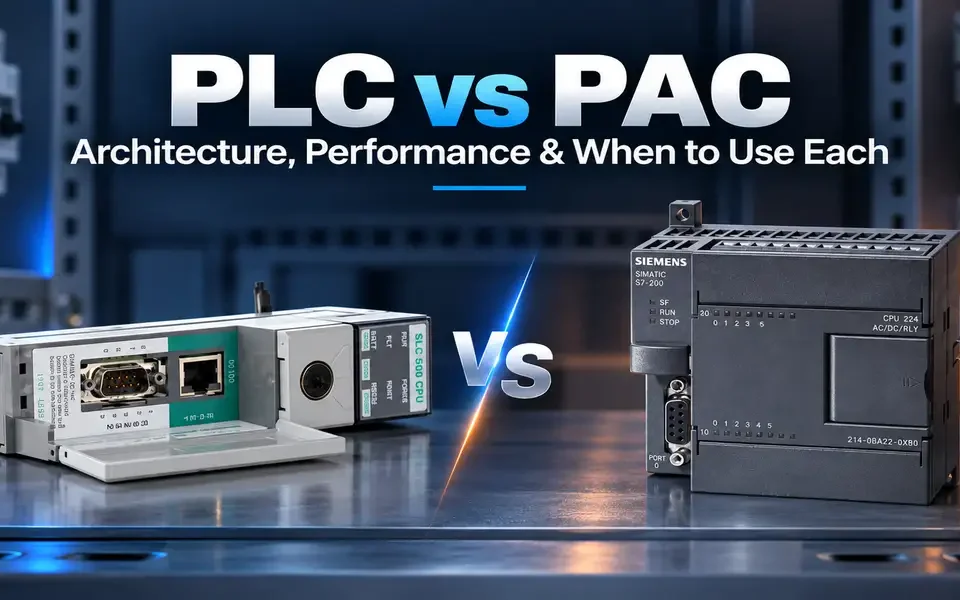
When comparing PLC vs PAC options, a PLC is often the practical choice for deterministic machine logic, modest I/O, familiar maintenance workflows, and controlled cost.
However, PACs become valuable when one controller needs to handle multiple areas of automation with complex scheduling, larger databases, and plant-level data exchange. While this is an important distinction to make, it certainly won’t apply to all scenarios.
With the modern capabilities of programmable logic controllers, they can complete tasks PACs have typically handled. And because of the differences in terminology and naming conventions of vendors, it is crucial to define the tasks, timing, I/O, protocols, software, cybersecurity, and lifecycle before choosing a model.
PLC vs PAC at a Glance
| Decision factor | Typical PLC fit | Typical PAC-style fit |
|---|---|---|
| Control scope | One machine or a bounded process cell | Several coordinated machines, process areas, or control disciplines |
| Execution | Simple cyclic scan or a small task set | Multiple periodic, event-driven, and priority tasks |
| Data model | Direct I/O references or a modest tag set | Large shared tag database and reusable data structures |
| Workload | Sequencing, interlocks, discrete I/O, limited analog control | Mixed discrete, process, motion, data logging, and system integration |
| Connectivity | A defined set of machine and field protocols | Many controller, supervisory, and enterprise connections |
| Engineering effort | Faster for a small, stable application | More scalable for a large, evolving application |
| Cost pattern | Lower initial hardware and engineering cost in a bounded job | Higher entry cost may be justified by consolidation and expansion |
The table below is for quick screening and notes some requirements which should not be considered hard specifications. Many features of aging PACs can be found in newer PLCs, and a small controller can offer great options for networking, logic, and motion.
The Label Is Not the Specification
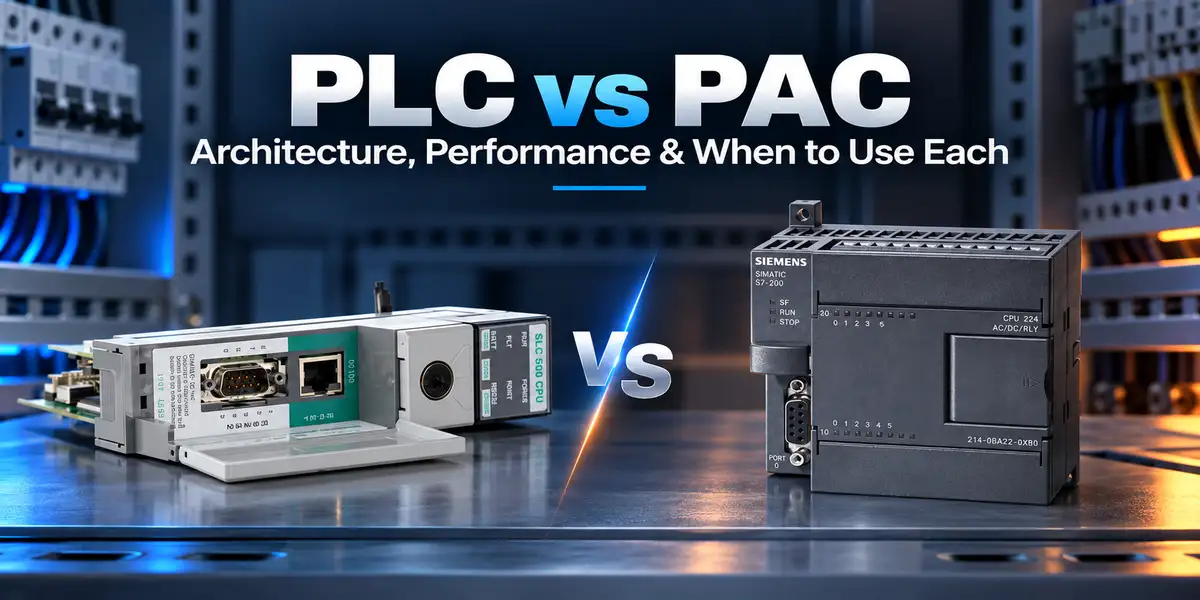
Both PLCs and PACs are used for automation and control of industrial environments. The line that separates PLC and PAC capabilities has become less distinguishable over time. PLCs were known for their machine reliability, with PACs known for greater flexibility, more robust computing and broader application integration.
Things have changed. Control Engineering reports that newer model PLCs have integrated all the things that used to set them apart — memory modules, communications, and even integrated process functions. Taking a similar perspective, Schneider Electric observes that the two categories are now similar in memory, distributed I/O, and communications.
That is why buyers should not assume that a PAC automatically guarantees better performance or that a PLC is limited by definition.
As part of your requirements, ask the vendor to link each element to a specific CPU, I/O family, firmware version, programming environment, and license. Product family terms simplify catalog searches, but validated criteria will determine if the system works.
Architecture: Compare the Project Model, Not the Enclosure
Architecture is about more than whether the controller is compact or modular. The existing Modular vs Compact PLC guide covers physical modularity and packaging.
When doing PLC vs PAC selection, focus on how the controller organizes execution, data, communications, and engineering work.
Execution and task organization
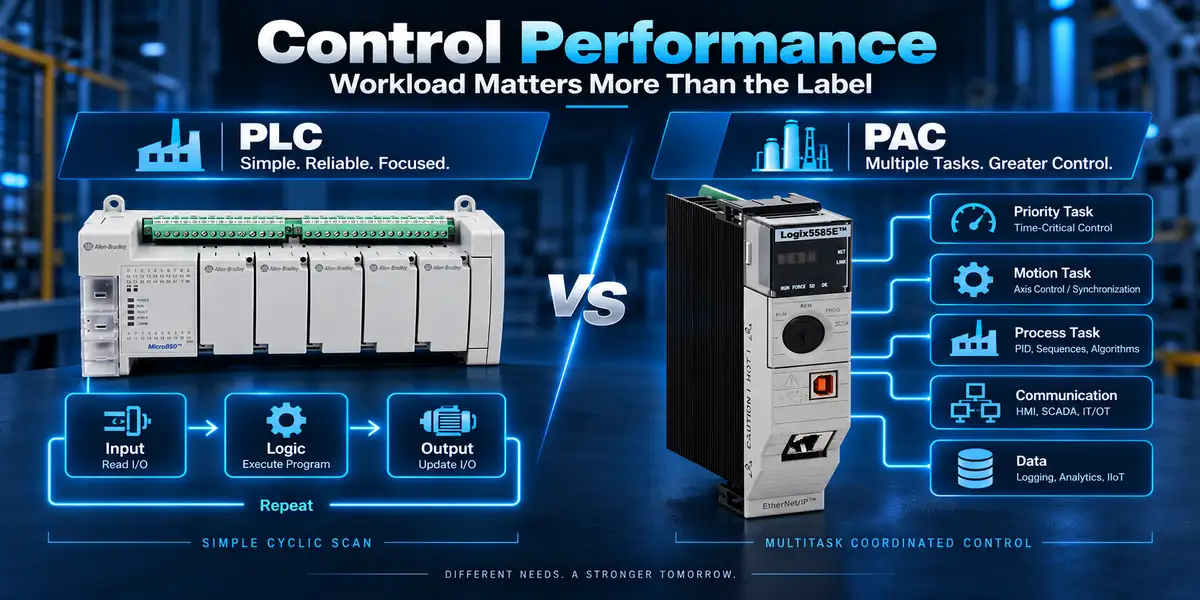
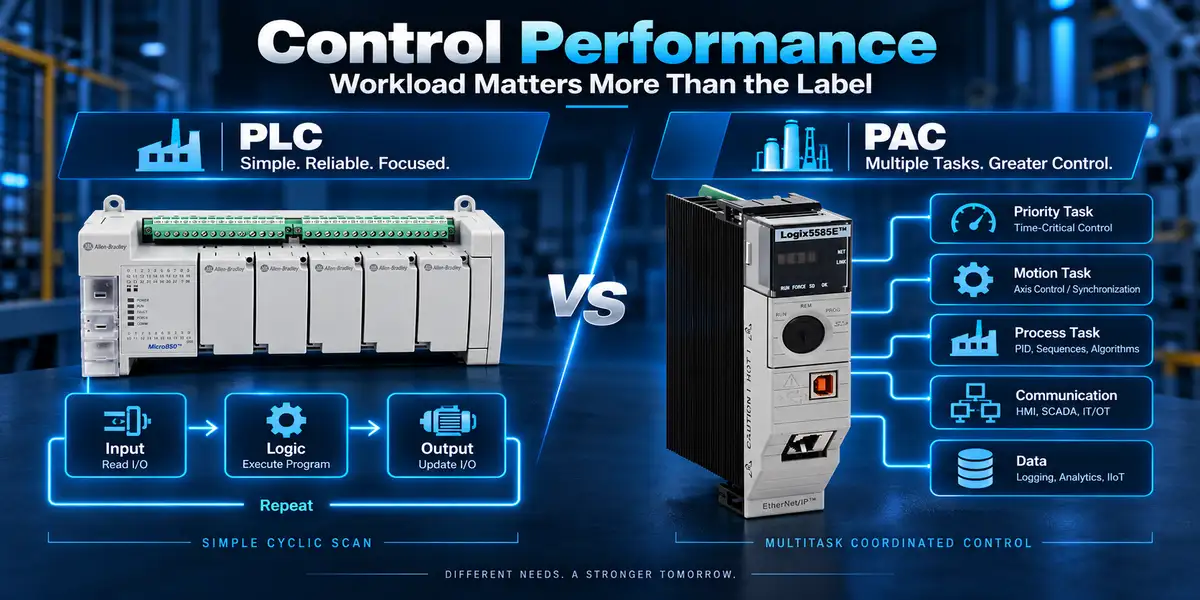
Traditional PLC models use a cyclical input-read, logic-execution, and output-update system. Models based on this system are easy to understand and troubleshoot. Modern controllers typically include periodic, event, interrupt, and motion tasks among others.
The true question to be asked in this case is not the traditional “Does it scan?” but “Can it schedule every required task with bounded latency under full load?”
PAC-style platforms are usually used when multiple fast, slow, and mixed control jobs must run in parallel. These control jobs may include fast machine interlocks, slower process loops, coordinated motion, recipe handling, data collection, and network services.
Priority and task isolation may be used to stop a noncritical task from delaying a critical task, as long as the application is validated and adequately engineered.
Memory and code organization
Legacy PLCs often include memory mapped with physical addresses. PAC-style environments prefer memory mapped with symbolic tags, structured data types, and reusable routines across the project. These structures can make projects easier to read and reuse, but they are no longer exclusive to PAC products.
Maintenance teams work with the system in an entirely different way. Can technicians monitor a signal without decoding an address map? Can tested code be reused across machines?
Are online edits allowed? How are revisions backed up and compared? What happens to tags, alarms, and HMI references when I/O changes?
Networks and data integration
Small machines typically require only local HMI, drive, and I/O connections. A larger, multi-area system may require distributed I/O, redundant paths, synchronized motion, plus SCADA, a historian, MES, database, or edge connectivity.
Add together the number of nodes and link requirements, specify how often updates happen, and outline all protocols that are involved. Listing something as basic as Ethernet is not satisfactory.
Verify the supported protocol functions, connection caps, time syncing, managed-switch requirements, and certificates. Also verify the method of segregating control traffic from business networks.
Performance: Measure the Workload, Not the Badge
High-Speed PLC. More powerful PAC. Labeling something like this does not tell someone about the system’s performance.
There are many considerations aside from instruction time. Things like how an I/O is updated, size of the program, traffic on the channel, motion axes, redundancy, safety tasks, and remote I/O impact the response.
Create an acceptance target based on workload.
- Define the fastest field event that the controller must detect.
- Set the maximum acceptable input-to-output response time and jitter.
- Identify the periodic, event-driven, motion, process, safety, and communications tasks.
- Estimate the full I/O and network load, including planned expansion.
- Ask for loaded-system benchmarks, or run a representative test with the selected CPU, firmware, modules, and topology.
A headline average is not enough. A controller that normally responds in 1 ms but occasionally misses the required window may be unsuitable. A predictable 5 ms cycle can still be entirely adequate for a slower process.
PLC vs PAC Decision Table
| Choose this direction | Strong signals | Verify before purchase |
|---|---|---|
| PLC | Standalone machine; stable scope; modest I/O; discrete sequencing; familiar ladder-logic support; tight initial budget | Scan/task time under load, I/O capacity, expansion, protocol limits, software and spare availability |
| PAC-style platform | Multi-domain control; several task rates; large tag structures; coordinated motion or process control; extensive data exchange; expected growth | Worst-case latency, task scheduling, memory, connection count, redundancy, security, license stack and engineering skills |
| Either may fit | Modern mid-range controller; moderate motion or process needs; one plant protocol; uncertain future scale | Compare exact models with the same workload, lifecycle horizon and support assumptions |
Send Simply Buy the application description, preferred brand, current CPU or I/O catalog numbers, protocol list, required delivery date, and destination.
As a multi-brand distributor and supply-chain integrator, we can help organize model matching and availability checks for a practical shortlist rather than forcing a decision from a label alone.
When a PLC Is the Better Fit
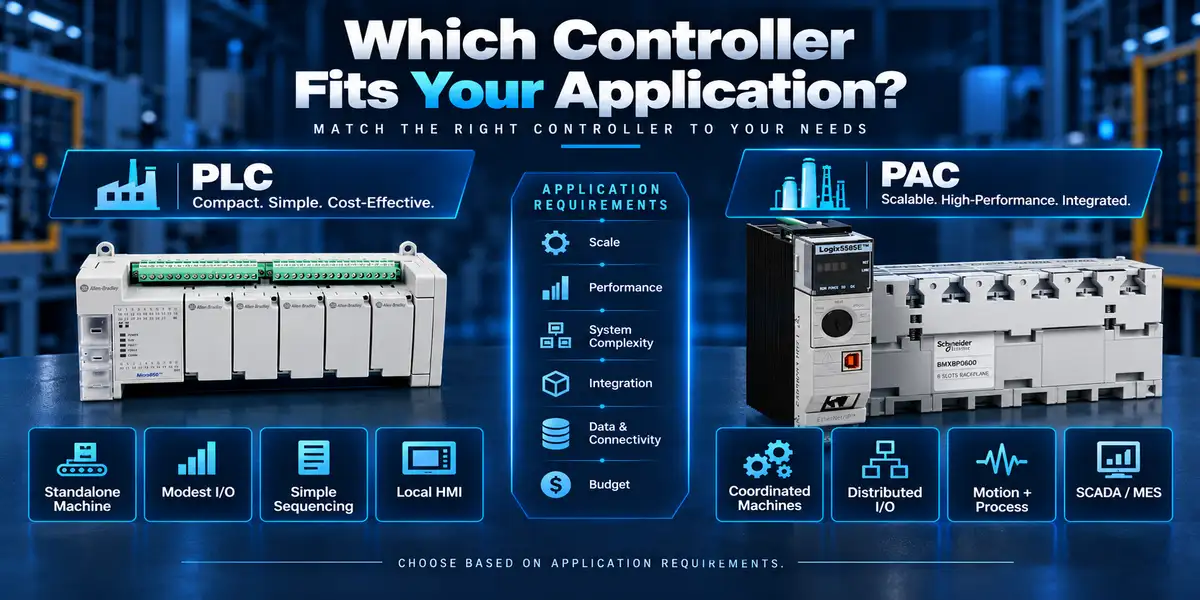
A programmable logic controller is the right choice when the project is limited in scope, and the system’s flexibility and breadth are less important than clarity, as is the case for conveyors, packaging equipment, pump skids, basic material handling, utility panels, etc.
A compact PLC may save on cabinet space and design time when its integrated I/O combined with its expansion capabilities are a good fit for the equipment.
For an installed base, a PLC may also be the safer commercial choice. If a factory has a trained PLC staff, a validated code base, a PLC support inventory, and a standard PLC programming environment, switching platforms may add more lifecycle cost than it removes.
For a customer base using the Allen-Bradley SLC 500, provide the complete catalog number and revision information: the family name is not sufficient for a proper response.
When a PAC-Style Platform Is the Better Fit
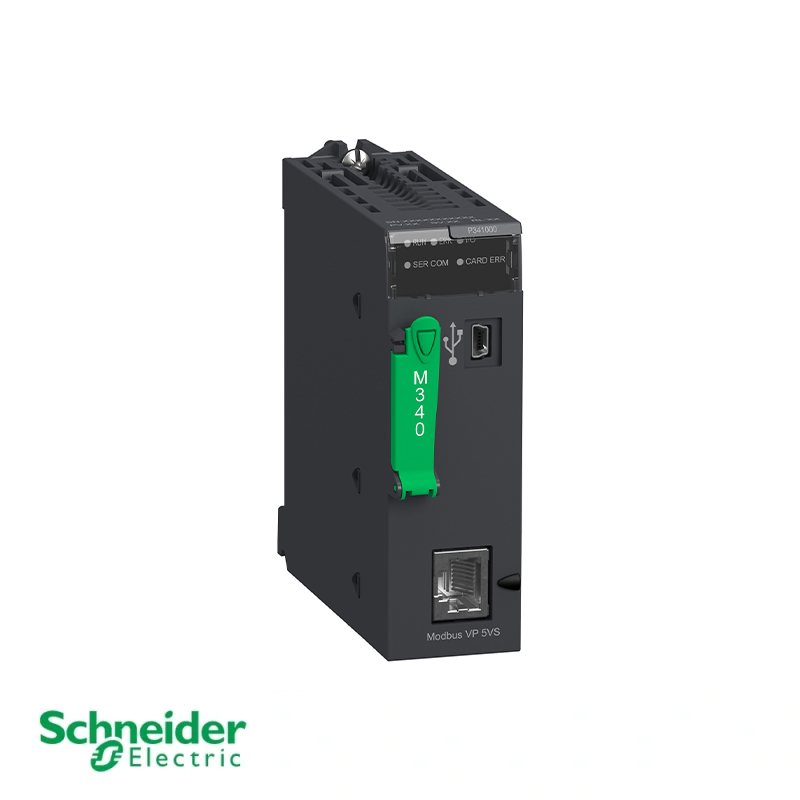
Series: Modicon M340
Product Type: Programmable Automation Controller (PAC)
I/O Capacity: Up to 1,024 digital / 256 analog I/O
A PAC-style platform makes sense when the controller must coordinate a system rather than sequence only one machine. This is especially true when a project consists of many I/O points and several task execution rates, complex analog functions, motion tasks, reusable modules, centralized diagnostics, or requires extensive data exchange with supervisory or enterprise systems.
A modular system can also make staged extensions easier when the limits for the backplane, rack, power, memory, and networks are defined.
A product family, for example, the Schneider Modicon M340 PAC, still requires a choice at the level of CPU, rack, power supply, I/O and communication modules, firmware, and software licenses.
Just because a project is big doesn’t mean it requires a PAC label. The work can sometimes be distributed across a modern modular PLC.
An example of this is a distributed Siemens ET 200SP fail-safe PLC CPU, which may combine compact packaging with advanced functions. When making these choices, think about what this model can actually do instead of what category it falls in.
Before You Replace or Migrate
Replacing a controller usually involves more than buying a CPU. Before migration approval, assess the entire control stack:
- I/O electrical types, channel count, terminal assembly, isolation, and field wiring.
- Rack, backplane, power budget, communication adapters, cables, and network topology.
- Limits on program conversions and the types of instructions, data, libraries, motion profiles, alarms, and HMI tags.
- Firmware and engineering software version, licenses, OS support, and backup files.
- Safety integrity concerns and the validation work required for a safety-related change.
- Protocol roles, device profiles, connection counts, remote I/O update time, and time synchronization.
- Environmental ratings and approvals; availability of certificates; documentation for the destination market.
- Strategy for spare part procurement, product lifecycle status, warranty route, lead time, and commissioning schedule.
If you are evaluating new suppliers as well as a new platform, use the PLC supplier evaluation guide to separate technical matching from authenticity, documentation, logistics, and after-sales questions.
What to Put in Your RFQ or BOM
For a faster and more reliable quotation, include the full controller and module catalog numbers, quantity, firmware or revision requirements, software and license needs, I/O list, network protocols, motion or safety scope, current system photos, destination country and postal code, required date, and any certificate or customs-document requirements.
Include required certificates and customs documents if applicable.
Ask the supplier to separate confirmed details from conditional ones: exact model match, genuine-product traceability, included accessories, available certificates, stock location, lead time, warranty route, and logistics terms.
DDP can be evaluated where relevant, but its availability depends on the destination, product, and shipment conditions.
Frequently Asked Questions
Is a PAC always faster than a PLC?
Not necessarily. Some PAC systems are designed to have more resources for processing, as well as more options for managing tasks. Ultimately, performance is tied to specifics like the CPU design, the architecture for I/O, the firmware, the program, the communications, and the motion or safety load.
You should evaluate the worst-case response time against what is needed for the application.
Can a PAC replace a PLC directly?
Not necessarily. The new platform must match the field I/O, communications, logic behavior, response time, safety functions, software, and HMI or SCADA interfaces. Program conversion and rewiring may still be required.
Is a modular PLC the same as a PAC?
No. “Modular” describes the physical hardware arrangement, while PLC and PAC describe broader controller positioning and capabilities. A modular PLC can provide advanced capabilities similar to a PAC, and a PAC can be sold in a form that is compact.
Which is better for high-speed machine control?
Either can be suitable. Choose a controller that can demonstrate the required event capture, task period, I/O update, motion synchronization, and maximum jitter under the planned load.
Often, a simple, optimized PLC will be a better choice than a larger platform with unnecessary complexity.
What information should a distributor verify before quoting?
A complete catalog number, revision and firmware constraints, I/O and protocol compatibility, required accessories and licenses, certificate needs, source traceability, stock, lead time, destination and delivery terms.
Source Your Controller with Fewer Surprises
To reduce sourcing surprises, send Simply Buy your full model numbers or BOM, quantities, controller and I/O requirements, destination country and postal code, required delivery date, and document needs.
We can compare options across brands, check model matching and available traceability documents, and evaluate lead-time and logistics routes for the project. Contact us by email, WhatsApp, or the website RFQ form for a sourcing review.
Technical References
- Control Engineering: PLC vs. PAC
- Schneider Electric: What’s the Difference Between a PLC and PAC?
- Machine Design: What’s the Difference Between a PLC and PAC?
- PLC Technician: Understanding the Differences and Values of Each